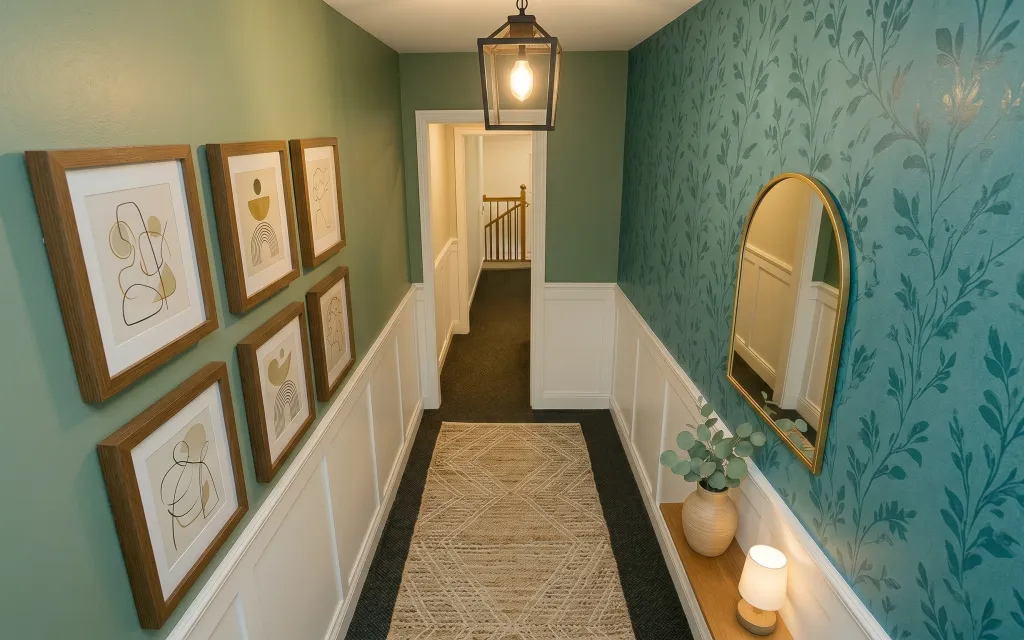
- Square footage
- About 60–80 sq ft (typical hallway runner stretch)
- Cost
- About $805 total for seven upgrades
- Difficulty
- Moderate DIY (measure-and-hang art)
- Renter-safe
- Not renter-safe if wallpaper is changed
Why olive wallpaper-and-gold mirror details are the hallway gallery nook of 2026
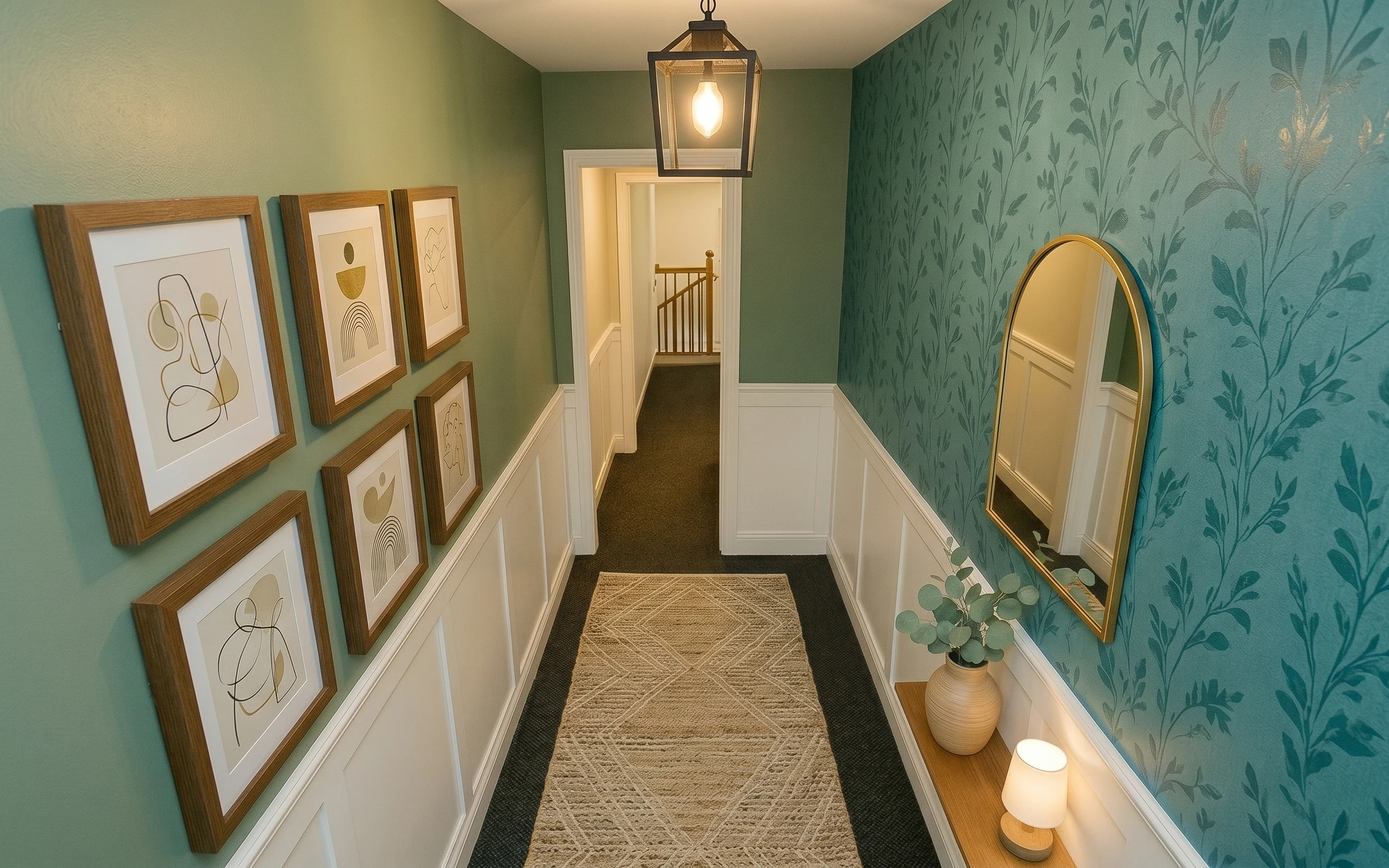
The starting point here is the green botanical wallpaper paired with white wainscoting, which already gives the hallway a “finished” look. The runner rug anchors the length of the space, while the framed abstract wall art makes the left wall feel intentional (not like a narrow hallway afterthought). On the right, the oval mirror and hanging lantern light add shape and warmth—so the space reads bright even when you’re walking through quickly. Best of all, these are weekend-friendly changes for homeowners who can commit to the highest-impact option first.
I almost overdid it the first time I hung art in a narrow hallway—too many pieces, too close together, and suddenly everything felt cramped. What flipped my brain was stepping back and treating the wall like a grid: consistent frame widths, even spacing, and a “breathing” gap where the mirror belongs. After that, the whole hallway looked calmer, even with bold wallpaper still doing the work.
Layer 1 — Beige runner rug with patterned texture ($120) Underfoot texture that softens every step
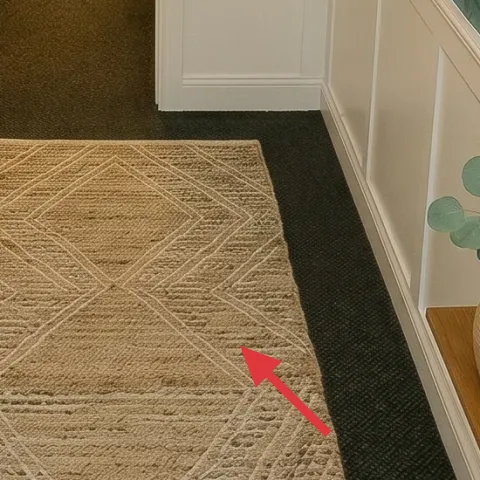
This beige runner rug with a patterned texture brings contrast against the dark carpet flooring and gives your hallway a clear visual route from entry to the far end. In a narrow space, a flat, solid rug can look “stuck” to the carpet, but this one adds movement without being busy enough to fight the wall art. The trade-off: you’ll want a rug that feels slightly structured, not ultra-pile, so it doesn’t snag or look lumpy underfoot. It also makes the whole space feel more curated than a bare-carpet pass-through.
Pick a runner that hides day-to-day marks
If you get tracked-in dirt, choose a rug with a light neutral base plus a subtle pattern instead of a single solid shade.
Layer 2 — Oval wall mirror with gold-tone frame ($120) A reflective shape that widens the hallway
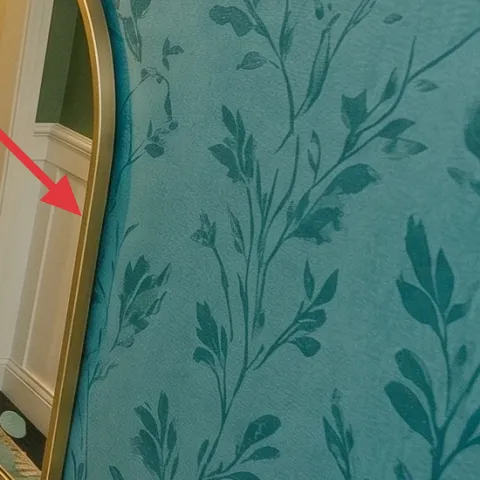
The oval wall mirror with its gold-tone frame is doing double duty: it breaks up the strong vertical lines of the wainscoting and it bounces light back into the hallway. In a space like this, a round mirror can feel too soft, and a rectangular one can look too “office,” so the oval shape lands in the sweet spot. The key visual trade-off is frame warmth—pairing gold with green wallpaper and white trim keeps the palette cohesive instead of turning the mirror into a separate accent. Hang it so the mirror catches the lantern’s glow for that warm, hallway-ready feel.
Match the mirror frame to your metal tones
Gold works especially well when your hanging light fixture also reads warm-metal rather than cool-chrome.
Layer 3 — Green botanical wallpaper on right wall ($150) One wall pattern instead of repainting everything
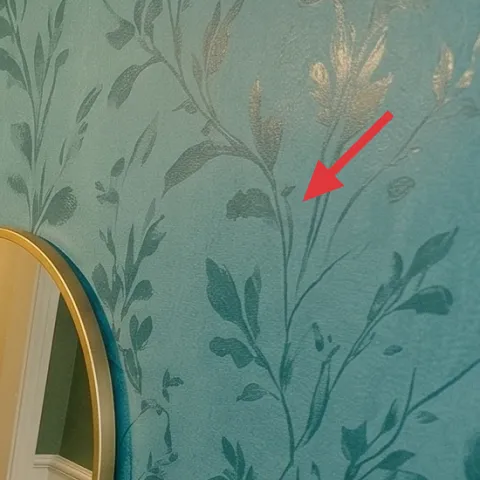
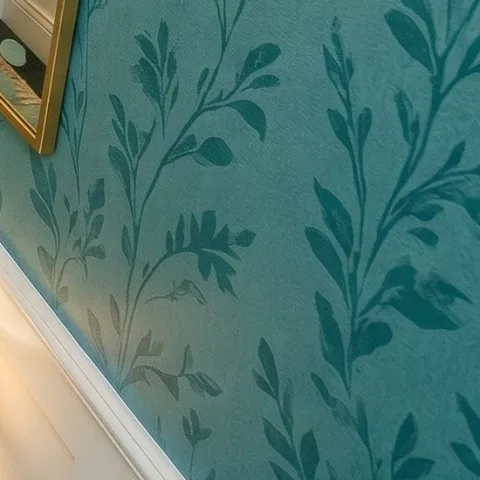
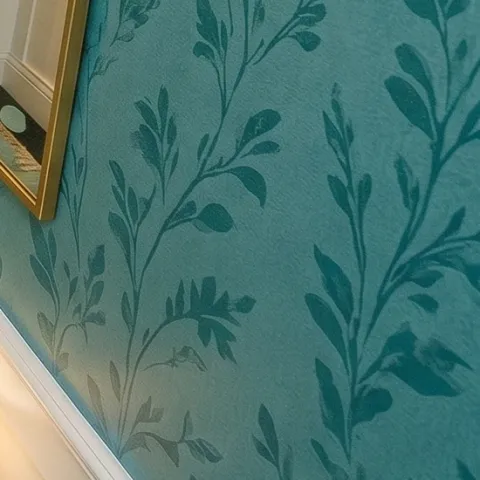
Green botanical wallpaper on the right wall is the fastest route to “room-from-the-photos” energy because it adds pattern and depth right where you look while walking through. Wallpaper also gives you more design control than paint: you can keep the white wainscoting untouched and still get a bold, styled background for the mirror. The main trade-off is commitment—once it’s up, it’s harder to pretend the hallway is still neutral. Choose a botanical pattern that reads scaled and not overly tiny, so it doesn’t compete with the framed abstracts.
Don’t place pattern where it will clash with frame spacing
If you crowd the framed abstract wall art too tightly, the wallpaper becomes visual noise. Keep consistent gaps so the hallway feels ordered.
Layer 4 — hanging lantern light fixture ($120) Warm overhead light for narrow hall clarity
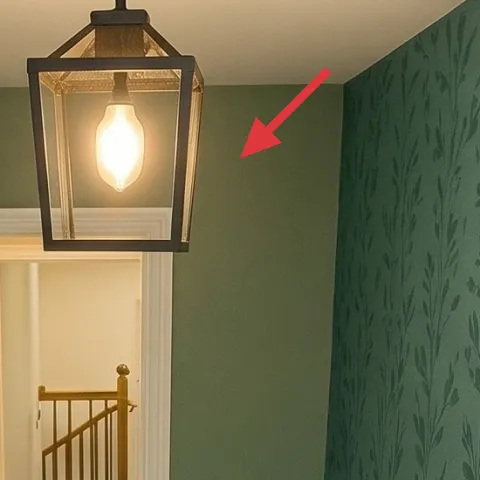
The hanging lantern light fixture is a huge part of why this hallway reads warm instead of harsh. Hanging lights also scale well in narrow corridors because they don’t “steal” floor space—your eye moves upward and the walls feel taller. The trade-off is bulb choice: a too-cool bulb can make green wallpaper look sickly, even if everything else is right. Stick to warm light and let the lantern’s glass/metal mix soften the edges around the mirror. This is also a better swap than changing multiple small lamps in a hallway.
Use warm bulbs so the wallpaper stays flattering
Warm light makes green tones feel rich instead of gray, especially next to white wainscoting.
Layer 5 — framed abstract wall art in matching wood frames ($180) A left-wall rhythm that makes the space feel designed
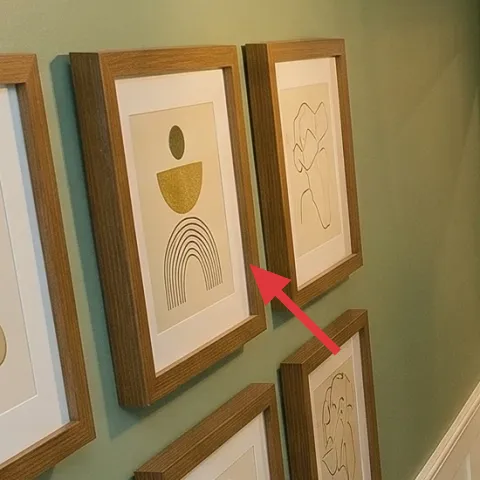
Framed abstract wall art in matching wood frames turns a plain side wall into a gallery that feels planned, not accidental. Because the frames are consistent, your eye reads it as one unit—perfect for a hallway where people glance quickly. The trade-off is spacing time: it’s worth measuring and laying the arrangement out before you hang anything, or the pattern will feel random. The subtle lines in the abstract prints echo the hallway’s geometry and help the wallpaper stay the star on the right. If you’ve only got a weekend, this is the layer where slow-and-straight pays off the most.
Keep frames aligned to sell the gallery effect
Even alignment—top edges or centers—matters more than “perfect symmetry” in a real home.
Layer 6 — wood side table by the mirror wall ($80) A landing spot for small styling
A wood side table by the mirror wall gives the hallway one practical surface for a vase and a light source, which makes the whole look feel lived-in. In narrow spaces, floating surfaces can feel too temporary, but a small table grounds the decor and gives the mirror a “destination” point on the wall. The trade-off is footprint: measure the walkway width so the table doesn’t make the hallway feel tighter. This table also visually ties into the wood tones of the framed abstract wall art frames, making the palette feel intentional.
Leave breathing room around the table
Center it so there’s space to walk by without bumping the mirror or the rug runner.
Layer 7 — painted white ceramic vase with eucalyptus stems ($35) A simple botanical cue that looks expensive
The vase with eucalyptus stems adds a soft, botanical “echo” of the wallpaper while keeping the styling airy instead of heavy. A white ceramic vase also plays nicely with the hallway’s white wainscoting, so the greenery reads fresh rather than chaotic. The trade-off: real stems take a little upkeep (trimming and refreshing), but it’s still easier than trying to keep faux greenery looking crisp in a warm hallway. I’d rather invest in a clean vase shape and swap stems occasionally than buy a bunch of small decor pieces.
Make it instead of buying it
DIY a painted white ceramic vase so the silhouette matches the eucalyptus styling, without paying for a “decor” labeled version.
Materials
- Ceramic vase (unpainted) — 1 — thrift/store — $10
- Primer for ceramic (spray or brush-on) — 1 small can — hardware store — $7
- Ceramic/appliance paint (white) — 1 small can — craft store — $5
- Paintbrushes (1–2 pack) — set — hardware store — $2
- Clear glaze/sealer for ceramics — 1 small can — hardware store — $1
Steps
- Clean the vase thoroughly and let it dry completely.
- Lightly scuff-sand the surface for better paint grip.
- Apply ceramic primer in thin coats and allow it to dry.
- Paint the vase with white ceramic paint in thin coats.
- Let paint fully cure per the can directions (drying is not the same as curing).
- Apply a clear glaze/sealer for durability, then cure fully.
- Trim eucalyptus stems and test the height inside the vase.
- Style the stems and check that the silhouette doesn’t block the mirror.
Total DIY cost: $25 — saves about $10 over buying.
The cost, layer by layer
| Layer | Item | Cost |
|---|---|---|
| 1 | Beige runner rug with patterned texture | $120 |
| 2 | Oval wall mirror with gold-tone frame | $120 |
| 3 | Green botanical wallpaper (one wall) | $150 |
| 4 | Hanging lantern light fixture | $120 |
| 5 | Framed abstract wall art in matching wood frames | $180 |
| 6 | Wood side table by the mirror wall | $80 |
| 7 | Vase with eucalyptus stems | $35 |
| Total | $805 | |
If you want a cheaper version, skip the wallpaper and go all-in on the runner rug plus the oval mirror. You can also choose thrifted framed abstract prints in similar wood tones to cut the wall-art cost while keeping the gallery feeling.
What worked, what didn't (across the whole room)
The strongest wins here come from pattern + reflection: green botanical wallpaper and the oval mirror make the narrow hallway feel longer and brighter. The runner rug and framed abstract wall art then “finish” the look so it doesn’t feel like decor pasted onto a corridor.
What worked
- The beige runner rug creates a clear walking path while softening the dark carpet texture.
- White wainscoting gives a calm base, so green wallpaper reads intentional rather than loud.
- The gold-tone oval mirror adds light bounce and interrupts the hallway’s vertical lines.
- Matching wood frames make the framed abstract wall art feel like one cohesive gallery.
- The hanging lantern light keeps the hallway warm, which flatters the green wallpaper tones.
- The wood side table gives a practical styling spot for the eucalyptus vase without clutter.
What didn't
- Too-different frame colors would fight the wallpaper—matching wood tones are key.
- If the rug pattern is too bold, it competes with the botanical wallpaper and art.
- Cool light bulbs can make green wallpaper look gray instead of rich.
- Overcrowding the framed abstract wall art creates visual noise in a narrow hallway.
What we'd skip if we did it again
Skip buying a second small lamp or extra decor pieces “just because the hallway feels empty.” In tight corridors, one warm light source plus a purposeful table vignette reads cleaner and takes less visual space.
Skip mixing metals. If the hanging lantern light fixture reads warm-metal, keep the mirror frame in the same family, or the gold will look accidental next to the wallpaper.
Skip going wallpaper-first without planning the wall-art spacing. The wallpaper wins, but the frames need even spacing so the gallery rhythm stays calm against the botanical pattern.
Frequently asked
How long does this hallway refresh usually take?
Plan on one day for wallpaper prep and application, plus a separate day for hanging the framed abstract wall art and placing the runner rug. The mirror and side table are quick, but measuring for frame spacing is what slows people down. Total time is usually 6–10 hours across a weekend, depending on how many frames you’re hanging and whether you need extra dry time between steps.
What if I rent—can I still get this exact look?
The mirror, runner rug, side table, and framed abstract wall art are all renter-friendly if you use removable hanging options for the frames. The big non-renter step is the green botanical wallpaper, so swap that layer for a large framed botanical print or removable wallpaper on a smaller section (if your lease allows). Keep the color palette: green + white wainscoting + warm wood frames.
My hallway is wider or narrower than the photo. What should I adjust?
If your hallway is wider, use a slightly wider runner rug and consider adding one extra framed abstract print to keep the left wall from looking sparse. If it’s narrower, stick to fewer frames and larger spacing so the gallery doesn’t crowd. For the oval wall mirror, keep it high enough to visually open the space but centered so it doesn’t feel like it’s “floating” above the table.
Where should I shop for the rug and framed art without overpaying?
For runner rugs, look for neutral patterned options at home stores with frequent sales, or search for “runner” in beige with geometric texture. For the framed abstract wall art, buying a set of matching wood frames from a single retailer helps the look stay cohesive without paying for custom framing. Thrifting can work too—just keep frame width consistent.
What’s the biggest mistake people make in a hallway like this?
Crowding. Hallways are narrow, so too many competing patterns and misaligned frames make everything feel busy fast. Another common slip is using cool bulbs with green wallpaper, which can mute the color and make the room feel dull. Treat the space like a grid: consistent frame spacing, warm light, and one bold pattern wall.
More in Small Spaces
Under $1000: olive-and-gold hallway gallery nook refresh
A weekend refresh for an olive-green hallway gallery nook: update the runner rug, add a gold-tone oval mirror, and wrap one wall in botanic…
Under $400: console nook refresh with botanical neutrals
A console nook refresh for shared housing that uses move-ready swaps—rug, lamp shade styling, and a DIY abstract print. Built on a $400 tot…
Under $600: warm japandi walk-in closet refresh with 7 layers
A warm japandi walk-in closet refresh with 7 budget-friendly layers—curtain panels, woven storage baskets, framed botanical art, and stylin…