- Best for
- weekend décor refresh
- Cost
- $770 total / $1000 ceiling
- Difficulty
- Easy-to-moderate weekend
- Time
- 4–7 hours
Why warm wood-and-terracotta details is the sofa-and-shelf living room of 2026
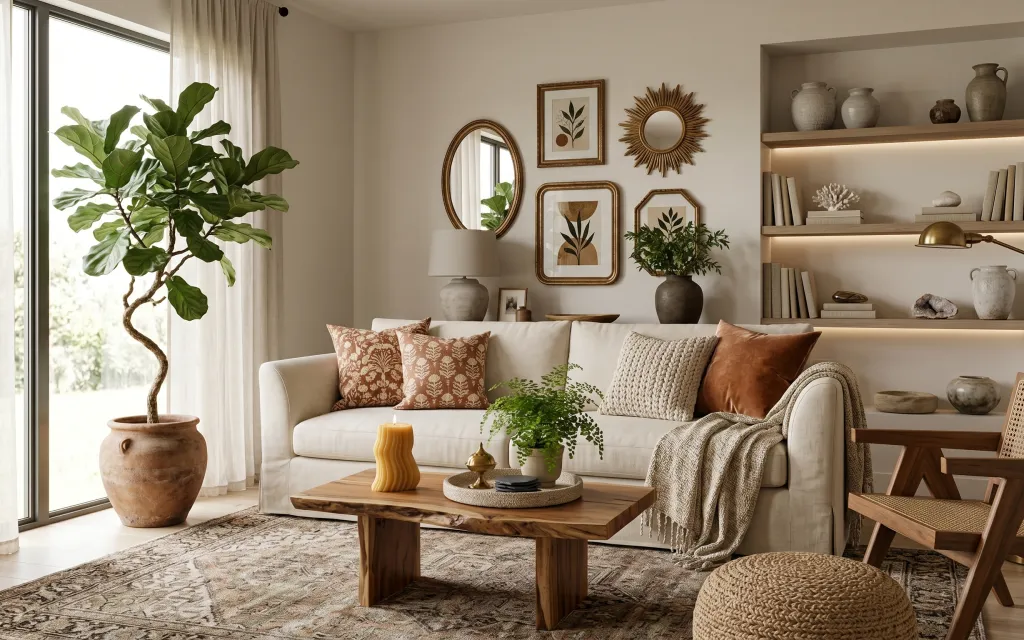
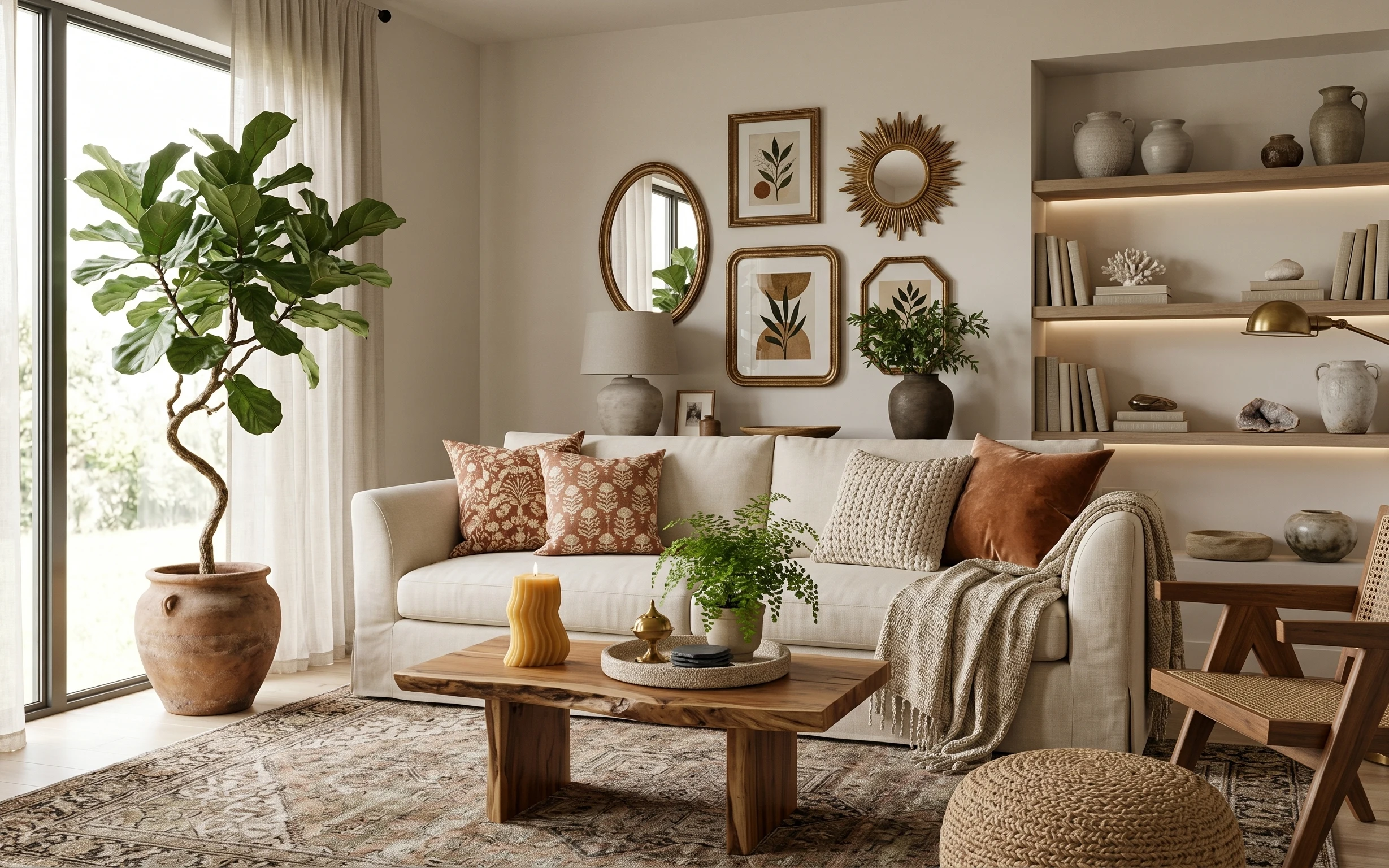
Start with the big, sensory pieces that read from across the room: the underfoot pattern, the sheer curtains near the window, and the warm wood coffee table. In this photo, cream upholstery and textured throws soften everything, while sage green plants add that “alive” feeling without changing your walls. The overall vibe is boho, but it’s held together by tidy shapes—oval mirror, framed botanicals, and brass light. For homeowners, the best part is picking the highest-impact option first, so the room feels finished after one weekend.
I used to save my “hard” upgrades for last—like the rug—then wondered why my room kept looking unfinished. What finally clicked for me was treating textiles and light like framing: get them right, then the décor can be playful. This layout is proof: the brass lamp and the mirror placement pull your eye up, while the rug anchors the sofa-and-table zone so the whole look stays grounded.
Layer 1 — area rug ($200) Patterned base that hides daily life
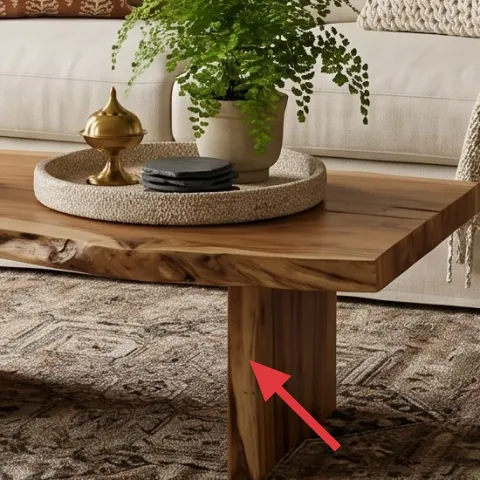
The area rug is the quiet backbone here. It’s not a plain neutral—there’s an allover pattern with warm greige and soft brown tones that make spills and daily wear much less noticeable. A 5×7 size is ideal for centering under the front of the sofa and letting the coffee table sit comfortably within the rectangle. The alternative (a flat solid rug) would show every footprint and small stain, especially in a bright room. If you like this look, lean into texture and pattern with warm undertones so the rest of the décor doesn’t have to do all the work.
Choose a rug with warm greige
Warm greige blends with brass and wood better than cool gray, so the room stays cohesive even when you mix prints.
Layer 2 — sheer window curtains ($80) Light control that still feels airy
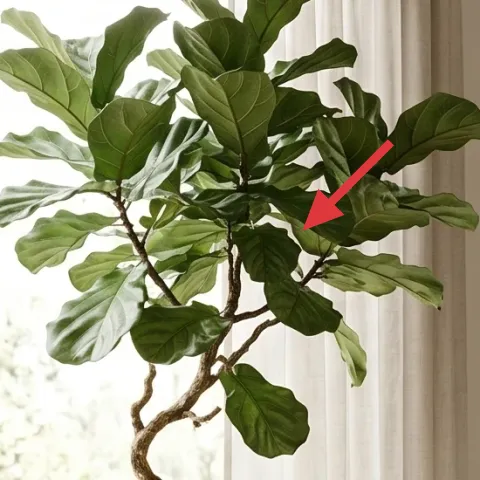
These sheer window curtains soften the strongest light source in the room. They keep the space bright while adding that “breathing room” feeling behind the cream sofa. When you’re going for boho-meets-modern farmhouse, sheer panels are a smart trade-off: they won’t block the view like heavier drapes, but they do create a soft backdrop for wall décor and plants. The visible texture is also what makes the room feel styled without being cluttered. Swap in a pair of 84-inch sheer curtain panels and hang them high for a longer, taller look.
Hang higher than the window trim
Higher placement makes the ceiling feel taller and gives the wall décor (mirror and frames) more visual breathing space.
Layer 3 — wood coffee table ($150) Warm surface for plants and candles
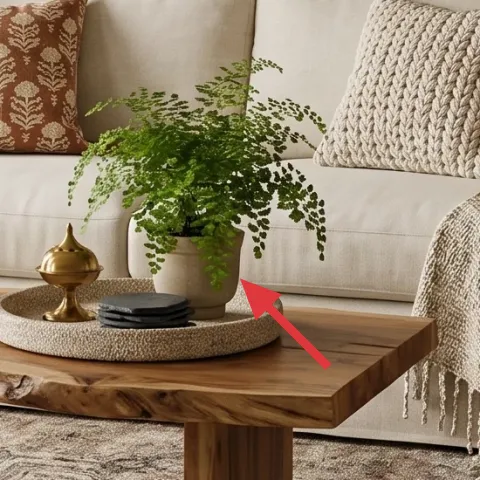
The wood coffee table is what makes the whole scene feel lived-in instead of just “decorated.” The warm brown tone connects to the shelf wood and keeps the cream sofa from looking too stark. It also gives you a surface that looks good even when it’s not perfectly curated—like when there’s a candle holder and a plant on top. I’d skip a glass or white table in a room like this because fingerprints and cold reflections fight the cozy textures. A darker wood grain option is especially forgiving and helps every small object (tray, candle, green leaves) look intentional.
Let the table hold 2–3 objects
A candle + one plant + one small tray keeps the coffee table styled without feeling crowded.
Layer 4 — brass swing-arm floor lamp ($120) Upward light for the shelf wall
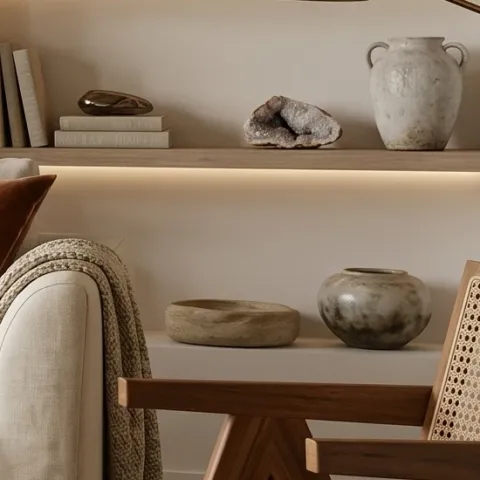
This brass swing-arm floor lamp does more than light—it “spotlights” the wall shelf and makes the mirrors feel like décor, not just reflections. Because the arm directs light, you get warm highlights on ceramic vases and the plant silhouettes instead of flat, shadowy illumination. The brass finish is a deliberate contrast against the white wall and cream textiles, and it’s also practical: it pairs with wood, terracotta, and greens without turning the room too colorful. The obvious alternative is a basic floor lamp, but that usually spreads light too evenly and makes the shelf feel less curated at night.
Don’t place the lamp too far from the shelf
If the lamp sits outside the shelf’s visual zone, it won’t create the same highlight effect on the ceramics and mirror.
Layer 5 — oval wall mirror ($100) A shape that softens busy walls
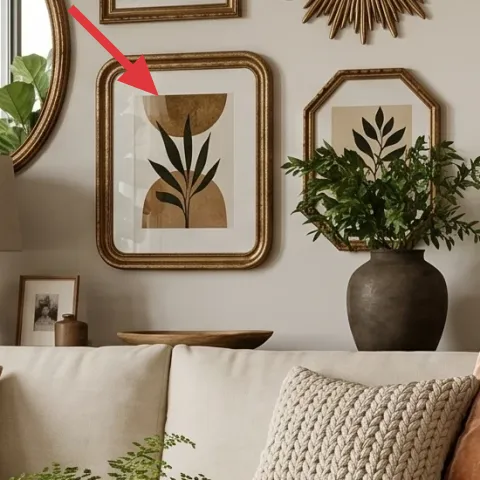
The oval mirror is the middle-ground shape that keeps the wall from feeling too busy. Rounder silhouettes read softer than a rectangle, especially when you’ve also got a starburst mirror and framed botanicals above and below. It also boosts light by reflecting the bright window area—so even in the evening, you get a sense of openness. The trade-off is that a larger mirror can feel “too much” if the wall already has multiple frames; an oval gives you presence without overwhelming the shelf styling. If you’re buying for your own room, choose a warm metal frame to echo the brass lamp.
Use the mirror to balance frame heights
Center the mirror so it lines up visually with the framed botanical cluster, not just the shelf itself.
Layer 6 — framed square botanical print ($80) One repeat pattern, multiple sizes
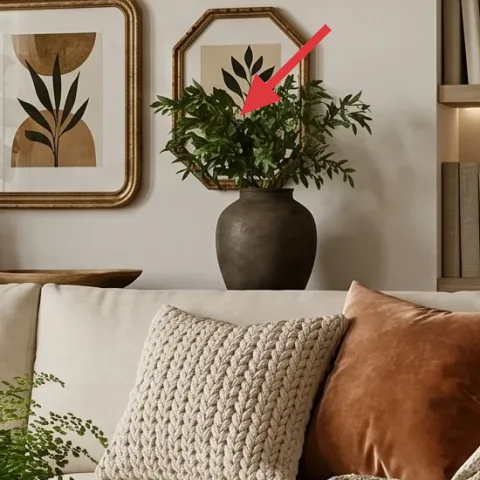
This framed square botanical print adds the “nature print” thread that ties the plants and earthy palette together. Botanicals are an easy win for boho rooms because they look organic without being trendy in a short-lived way. The key here is scale: the square sits among taller frames and keeps the whole grouping from looking lopsided. If you instead used an abstract print, the wall would compete with the green leaves and terracotta textures. A botanical print also helps your eyes move between the shelf items and the mirrors, making the wall feel curated rather than random.
Match print tones to your plants
Look for browns and muted greens in the art so the plant shapes feel intentional, not accidental.
Layer 7 — medium terracotta planter ($40) DIY color that looks “collected”
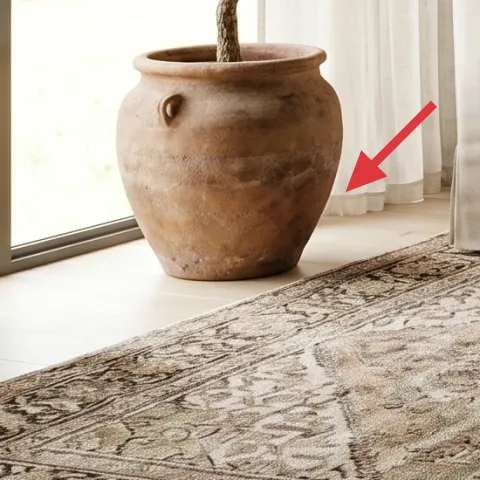
Make it instead of buying it
Paint a small set of terracotta planters the same warm tone you see here, so your shelf and table plants look styled as a set instead of mismatched.
Materials
- Spray primer (terracotta-compatible) — 1 can — hardware store — $10
- Warm ochre/terracotta craft paint — 1 small jar — craft store — $8
- Paintbrush set — 1 pack — big-box store — $5
- Matte clear sealant — 1 can — hardware store — $12
Steps
- Lightly scuff the terracotta with fine sandpaper, then wipe off dust.
- Spray on a thin, even coat of primer and let it dry fully.
- Paint the first color coat with light pressure for even coverage.
- Let the paint dry, then add a second coat if you can see through.
- Distress edges lightly with sandpaper if you want a collected, aged finish.
- Seal with a matte clear coat to protect the finish and let it cure per label.
Total DIY cost: $35 — saves about $5 over buying.
The cost, layer by layer
| Layer | Item | Cost |
|---|---|---|
| 1 | Area rug (5×7) | $200 |
| 2 | Sheer window curtains (84" panel pair) | $80 |
| 3 | Wood coffee table | $150 |
| 4 | Brass swing-arm floor lamp | $120 |
| 5 | Oval wall mirror (warm frame) | $100 |
| 6 | Framed square botanical print | $80 |
| 7 | Medium terracotta planter (DIY retail equivalent) | $40 |
| Total | $770 | |
If the rug budget is tight, go one step simpler with a lower-cost patterned rug (or a close-to-warm-beige neutral) and spend those savings on the lamp and mirror hardware—those changes show the fastest at night.
What worked, what didn't (across the whole room)
The strongest win is how the lighting and wall shapes lift the look: the brass lamp plus the oval mirror make the shelf feel intentional. The rug and curtains also work together, creating a soft base that keeps the plants and botanicals from feeling like clutter. The only miss area was expecting one “hero” item to fix everything—when the coffee table styling went too matchy, the wall décor had to do extra work.
What worked
- The patterned rug hides footprints and makes the cream sofa feel grounded instead of floating.
- Sheer curtains keep the window bright while adding texture behind the wall décor.
- The brass swing-arm floor lamp creates highlights on ceramics and reduces harsh shadows at night.
- The oval mirror softens the wall so framed botanicals don’t feel too boxy or stacked.
- Warm wood tones tie the coffee table to the shelf, making the whole palette feel cohesive.
- Terracotta accents make greenery look styled rather than randomly placed.
What didn't
- A solid, low-texture rug would have shown every small stain and didn’t match the boho rhythm.
- Too many small items on the coffee table made the foreground feel busy and visually loud.
- Placing the floor lamp slightly too far from the shelf reduced the “spotlight” effect on the ceramics.
- If the mirror frame were cool-toned, it would clash with brass and make the room feel unbalanced.
- Choosing a single oversized print instead of mixed botanical sizes would crowd the wall shelf area.
What we'd skip if we did it again
Skip buying a plain neutral rug unless it has enough texture. In a room with cream upholstery and lots of small décor, a patterned rug is what keeps the whole front area from looking flat.
Skip a floor lamp that can’t direct light. A simple dome or upward-only lamp won’t highlight the shelf and mirror the way a swing-arm does.
Skip matching every ceramic color exactly. The “collected” look comes from one repeating note—warm terracotta and brass—while each vase can still be slightly different.
Frequently asked
How long does this kind of living room refresh take?
Most of the time goes to the “big moves”: getting the rug centered, hanging the curtains high, and placing the mirror and framed botanical print so the wall feels intentional. Plan about 4–7 hours for a first pass, then 30–60 minutes to style the coffee table and shelf. If you’re painting the planters, add another 1–2 hours spread across drying time.
What if I rent—can I still do the same look?
Yes, especially the textiles and lighting. Rug, curtains, framed art, and decorative lamps are all renter-friendly. For wall décor, use removable mounting options rather than permanent holes. The key is to keep the palette consistent (cream, warm wood, sage green) so your mix of removable pieces still reads cohesive.
My living room is smaller—should I downsize the rug and curtain panels?
Downsize the rug only if it can still sit under the front legs of the sofa. If the rug is too small, the seating area won’t feel anchored. For curtains, use the same hanging height trick (high and wide) even in smaller rooms—sheers will keep things light while visually stretching the window.
Where should I shop for these exact items?
Look for the rug and curtains at big-box home stores or flooring retailers, then add the wall pieces from art-focused sellers or home decor boutiques. For the brass swing-arm lamp, search for “swing arm floor lamp brass” and prioritize the shade material and adjustable arm range. For botanical prints, match frames to warm metal tones.
What’s the biggest mistake in rooms with a lot of wall décor?
Overloading the coffee table and the wall at the same time. If the wall already has multiple mirrors and framed botanicals, keep tabletop styling to two or three items and use repeats—like terracotta and warm brass—so your eye has a clear path through the room.
Can I swap the botanical print for something else?
You can, but keep the same job the print is doing: connecting plants to the wall. A safe swap is another nature-themed print with muted greens and warm browns, or a line-art print in a similar palette. The goal is not matching every color—it’s matching the undertones so the décor feels like a collection.
More in Living Room
Under $1000: warm wood-and-terracotta sofa-and-shelf living room refresh
A weekend-friendly living room refresh built around warm wood, cream textiles, and earthy greens. With 7 visible swaps/add-ons, the look la…
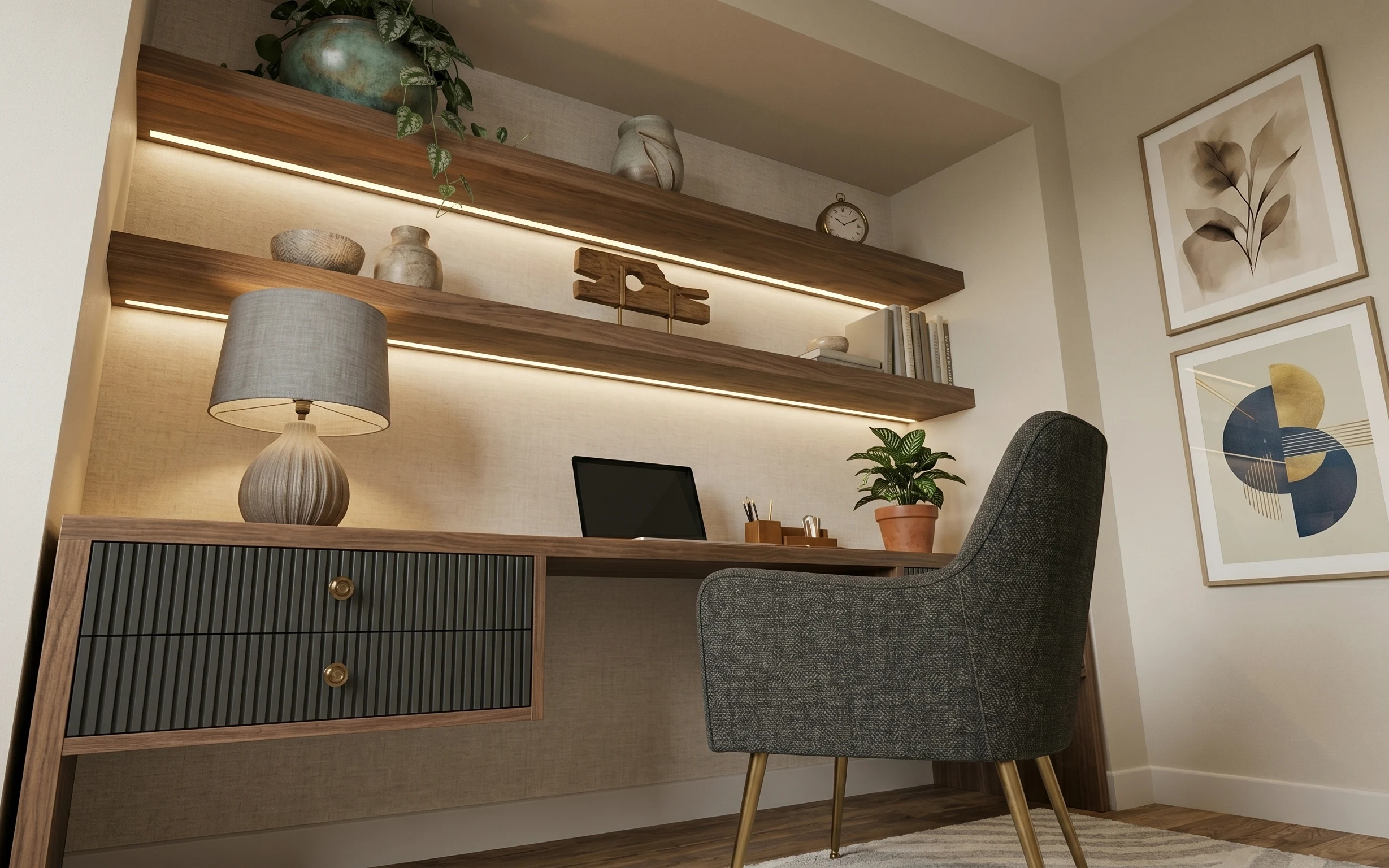
Under $700: warm walnut shelf corner refresh with 7 layers
A warm walnut shelf reading corner refresh that leans japandi: soft light, grounded neutrals, and plant styling. This makeover uses 7 budge…
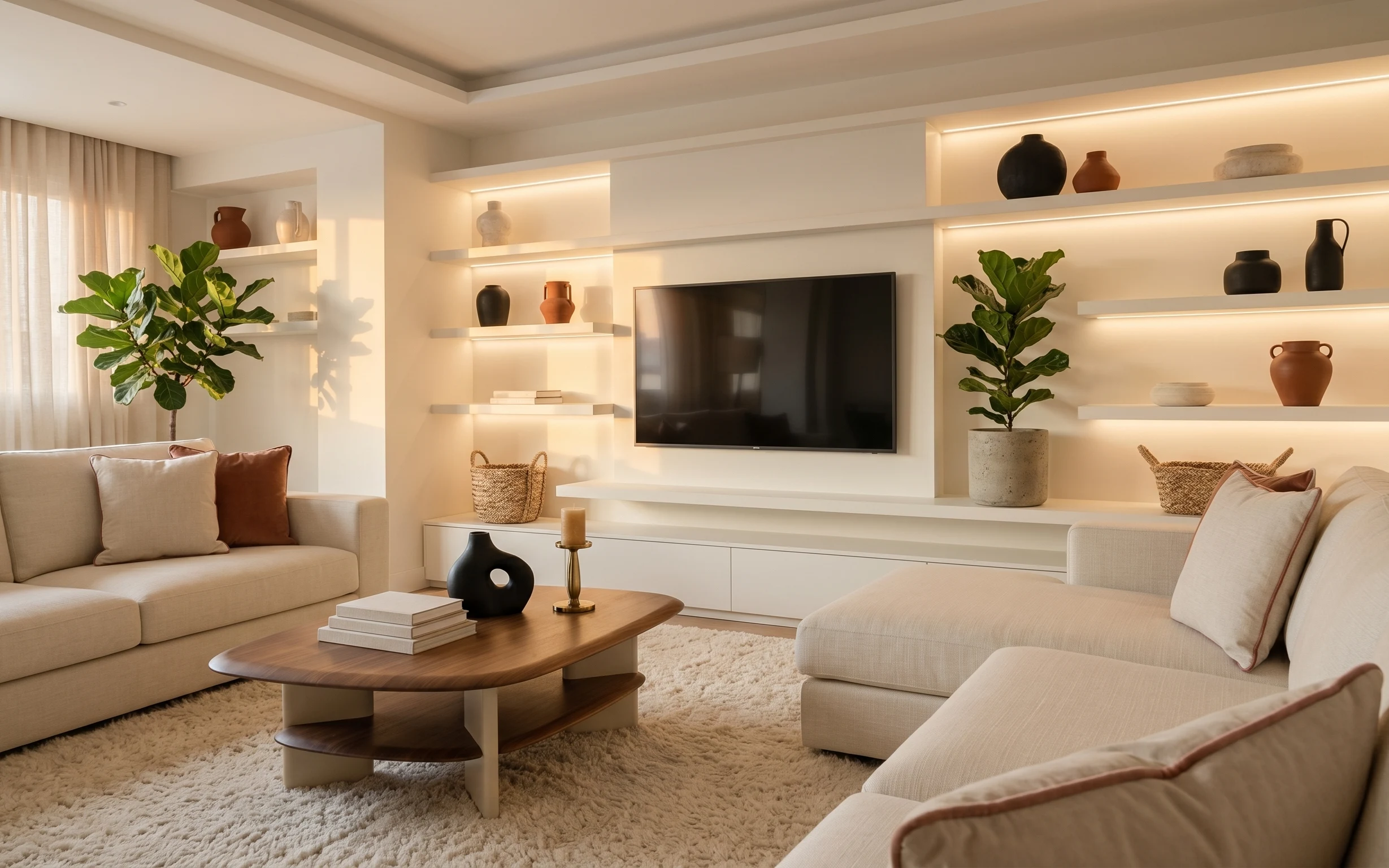
Under $500: warm beige-and-black sofa-and-shelf lounge refresh
A warm neutral sofa-and-shelf lounge is all about soft layering: a plush beige rug, airy cream curtains, and a few earthy decor swaps that …