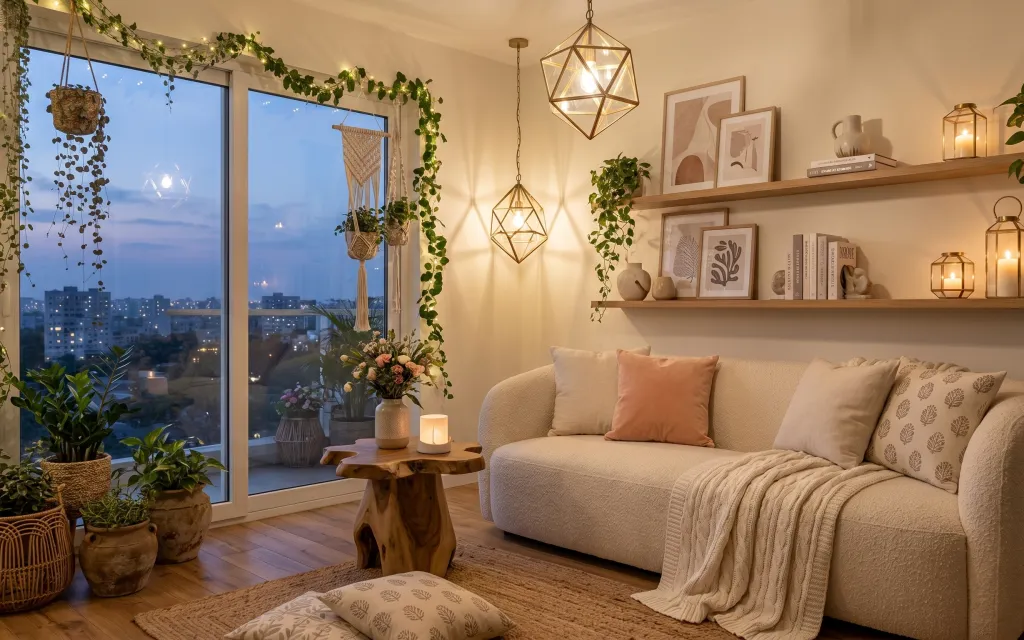
- Best for
- Layered lighting and portable wall texture
- Cost
- Total about $355
- Difficulty
- Easy (no-drill swaps)
- Time
- A weekend afternoon
Why warm string-light-and-knit styling is the living room corner of 2026
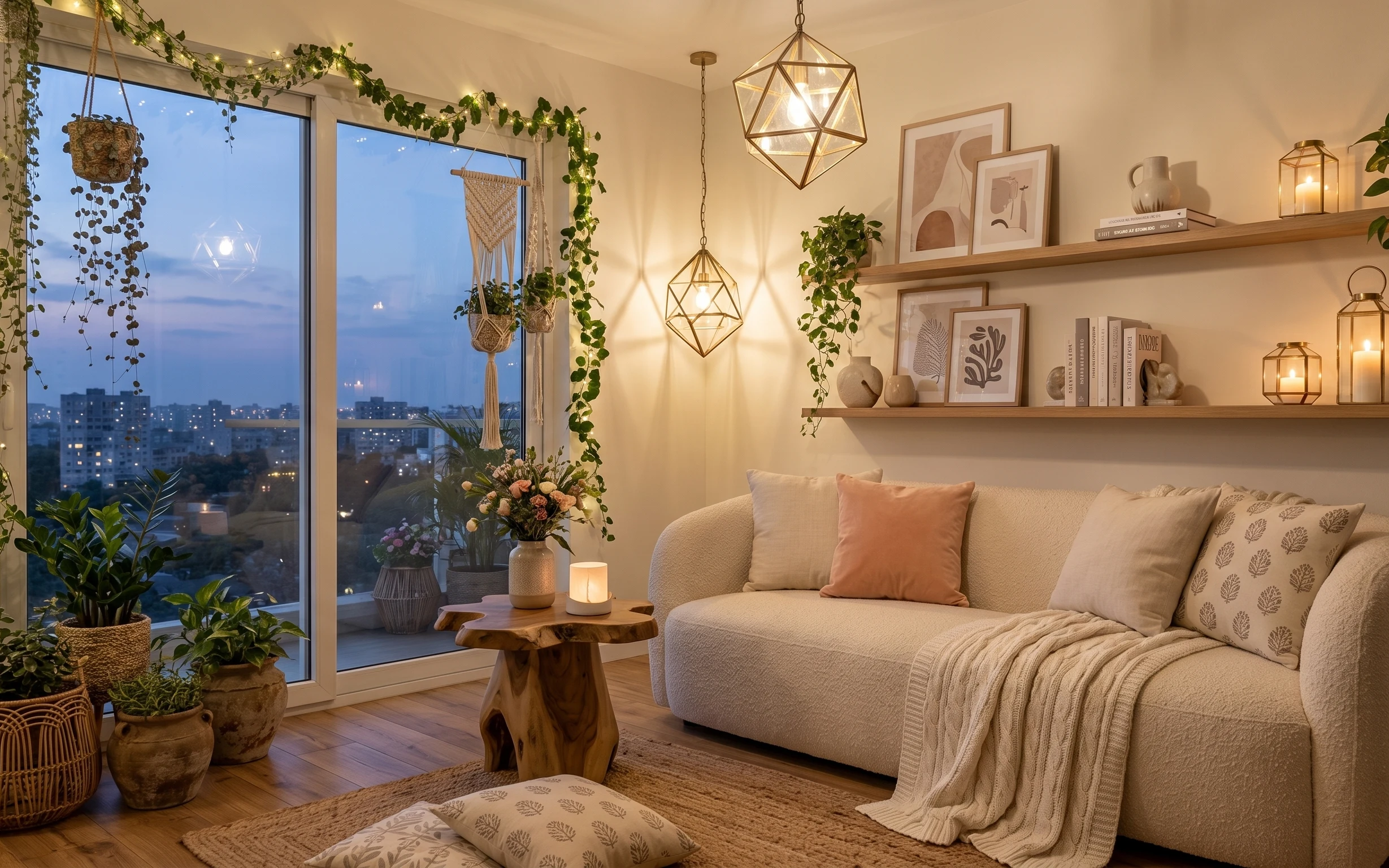
The fastest way to copy this vibe is to treat it like a layering system, not a single “decor choice.” In the photo, you can see warm wood tones, cream upholstery, and knotted plant texture hanging near the window. The rug anchors the whole seating area, while the knit throw and patterned pillows add movement you can keep even as your couch changes. Finally, small light sources—like candle glow and window string lights—make the space feel intentional after dark, without any permanent installs. All of these are easy for shared housing because they pack into boxes when the lease ends.
I once overcommitted to wall décor in my first shared house—one season in, I realized everything needed to come down cleanly. The change that stuck: I started choosing “portable hooks” and soft goods first, then added one low-risk wall item that can be reused. That’s basically the order here: rug and textiles first, warm lighting next, and then a single hanging macramé moment where it can be removed without damage.
Layer 1 — area rug 8×10 (olive-and-cream pattern) ($150) Ground the seating area with one pattern
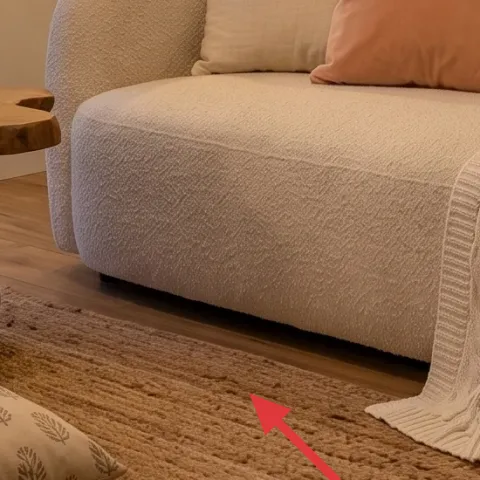
That patterned rug is the visual anchor for everything to come—especially in a shared living room where the seating usually gets used from multiple angles. Go for a roughly 8×10 size so the coffee table and front sofa edge feel “connected” rather than floating on bare floorboards. The olive-and-cream palette also plays nicely with the olive greenery and warm wood tones already in the room, so you’re not fighting the existing color story. The trade-off: a larger rug costs more than a runner, but it saves money later because fewer pieces are needed to make the room look complete.
Step on it to check scale
Before buying, measure how much of the coffee table footprint sits inside the rug’s perimeter—aim for full table center support, not “mostly under.”
Layer 2 — knit throw blanket on sofa ($45) Add weight and texture in one sweep
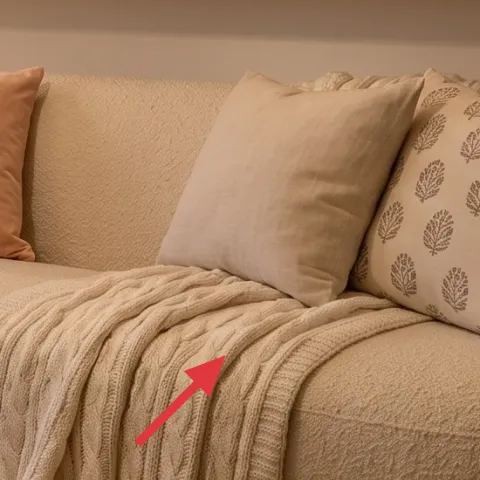
This knit throw reads cozy because it’s thick enough to show texture from across the room and because it’s draped, not “perfectly placed.” Choose a neutral knit in cream or oatmeal so it blends with the sofa and doesn’t compete with patterned pillows or botanical art. Drape it over the sofa arm or along the seat edge so it looks natural when someone actually sits there. The trade-off is that knit can pill if it’s too rough; a washable, tighter-knit throw is easier to keep looking good for months. For a move, it’s a win: it folds flat and fits into a standard box without wrestling.
Drape direction matters
If it falls straight down, the room can feel heavy; letting it break over the sofa edge keeps the texture airy.
Layer 3 — decorative throw pillows on sofa ($30) Repeat the room’s colors in small doses
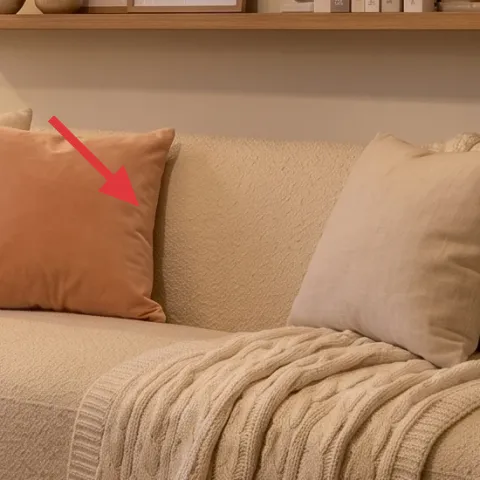
In the photo, the pillows echo the cream base with warmer accents, which is why the sofa looks styled instead of sparse. For a refresh, swap to two matching pillow covers that share the same “tone family” as the throw—cream plus a subtle botanical or warm neutral pattern. The visual win is repetition: the eye keeps catching the same colors in different fabrics. The trade-off is that fewer pillows can look too minimal, so aim for two to three total items rather than one. Choose covers over permanent bedding changes so everything stays packable and renter-safe for your next move.
Use covers, not full inserts
Cover swaps are cheaper than replacing inserts, and they travel better—especially when you don’t know your next couch size.
Layer 4 — framed botanical prints on wall shelf ($25) Pick one print with the right linework
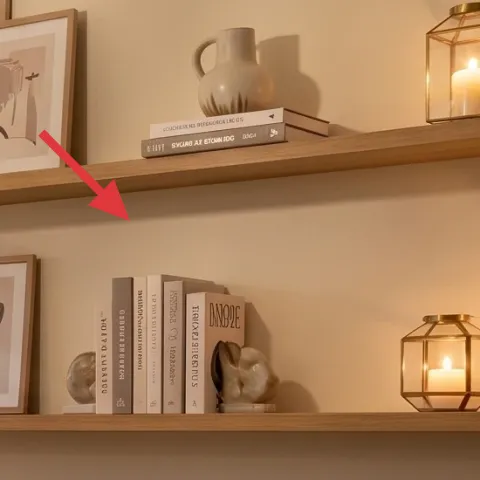
These framed botanical prints work because the line style is light and the palette stays in the same warm, earthy family as the plants. When you’re building a move-ready look, it’s easier to commit to one or two new frames than to rework the whole shelf arrangement. Pick a 16×20 framed art print with similar botanical linework, then rest it on (or lean it toward) the shelf so you can remove it quickly. The trade-off: framed prints are easier to damage than pillows, so use proper corner protection when packing. The upside is that frames feel “finished” even when everything else is simple.
Skip oversized frames if the wall shelf is shallow
If the frame overhangs, it looks cramped and can tip during packing—measure shelf depth before ordering.
Layer 5 — string lights on window and greenery ($15) Make every evening look intentional
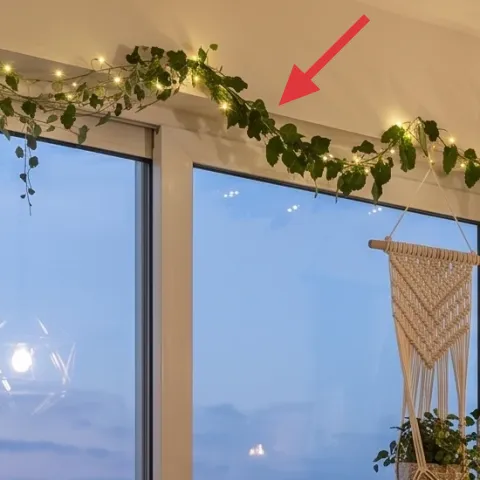
String lights are doing a lot of work here: they brighten the window area and create that soft, warm glow around the hanging greenery. To copy the effect without permanence, buy a string light set and drape it over the existing plant supports and around the window frame using removable clips or Command hook methods that won’t wreck the finish. Keep the lights slightly higher than eye level so they throw a gentle halo rather than bright points. The trade-off is battery life; opt for a plug-in set or plan for easy replacement. This is still very renter-friendly because it packs in a small bag and unravels quickly when you move.
Choose warm white
Warm white reads like candlelight against cream walls, while cool white can make the whole corner feel sterile.
Layer 6 — glass lantern candles on wall shelf ($35) Add flicker without needing extra fixtures
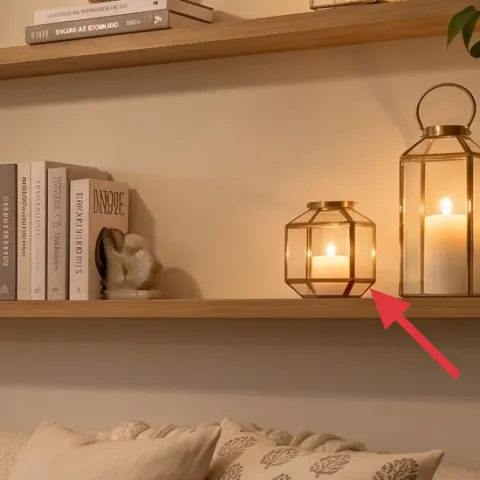
Those glass lantern candles bring movement that’s hard to recreate with just lamps, especially in a shared space where overhead lighting is usually harsh. Look for lanterns with a glass body so the flame reads softly through the panels. Place them on the shelf (or on a coffee table centerpiece) so the light source stays contained and visually cohesive with the other warm tones. The trade-off: candles require basic safety habits, and wicks need replacing occasionally. For impermanence, it’s perfect—lanterns are light, store easily, and you can reuse the same glow effect anywhere there’s a flat surface.
Group by height, not by matching
Even if lanterns aren’t identical, varying heights keeps the shelf from looking like a line of identical candles.
Layer 7 — macramé plant holder by window ($55) Add hanging texture with removable hardware
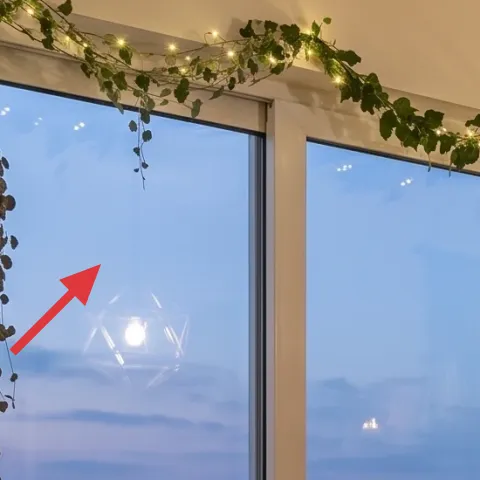
That hanging macramé piece gives the corner its “you tried” texture without adding bulky furniture. For shared housing, this is one of the smartest decorative choices because it can be re-hung wherever you land next. Make it removable with a Command hook and a small dowel so no drilling is needed, and choose cord tones that match the room’s warm woods and cream walls. The trade-off is that macramé looks best when it has a little slack and movement—so don’t pull it too tight during hanging. Once it’s up, it becomes the vertical element that balances the rug and sofa textures.
Make it instead of buying it
DIY a macramé wall hanging using cotton cord, a small dowel, and a removable Command hook so the hanging texture moves with the next lease.
Materials
- Macramé cotton cord — ~60 ft — craft store — $15
- Wood dowel — 12–18 in — craft store — $12
- Command hook (for removable hanging) — 1–2 hooks — home goods store — $8
- Wooden beads or plant charm (optional accents) — small pack — craft store — $6
- Jute twine tie-back — 1 spool — craft store — $2
Steps
- Cut cord strands to length (longer for drape), then group them evenly so the pattern hangs balanced.
- Anchor strands to the dowel using a secure wrapping method, keeping tension consistent across all cords.
- Work the knot pattern rows (like square knots) until the hanging panel hits the desired height.
- Add any beads as you reach the finishing section, spacing them so they don’t crowd the center.
- Trim cords evenly, then tie a final loop or tie-back so the hanging end looks intentional.
- Mount with a Command hook near the window/plant area and hang the dowel loop so it sits centered.
Total DIY cost: $43 — saves about $12 over buying.
The cost, layer by layer
| Layer | Item | Cost |
|---|---|---|
| 1 | Area rug 8×10 (olive-and-cream pattern) | $150 |
| 2 | Knit throw blanket on sofa | $45 |
| 3 | Decorative throw pillow covers | $30 |
| 4 | Framed botanical print 16×20 | $25 |
| 5 | String lights (set) | $15 |
| 6 | Glass lantern candle | $35 |
| 7 | Macramé wall hanging (DIY equivalent) | $55 |
| Total | $355 | |
A cheaper variant is to swap the 8×10 rug for a smaller size or a lower-cost pattern, choose two pillow covers instead of adding extra textures, and use one glass lantern candle instead of multiple pieces on the shelf—keeping the warm glow and vertical interest.
What worked, what didn't (across the whole room)
This corner looks cohesive because texture shows up everywhere: rug pattern, knit throw, and hanging greenery all repeat the warm neutral palette. The small lighting sources make the scene feel styled after dark. The only weak spot is when too many “small focal points” compete at once.
What worked
- The rug’s olive-and-cream pattern ties the sofa and coffee table together visually from across the room.
- The knit throw adds tangible texture so the sofa doesn’t read flat in photos or low light.
- Throw pillow color repetition keeps the palette consistent without needing major color changes.
- Framed botanical prints add line detail that matches the plants’ organic shapes.
- String lights create a warm window glow that stays renter-friendly and packable.
- Glass lantern candles add flicker without needing any permanent ceiling changes.
What didn't
- If the rug is too small, the coffee table looks like it’s sitting on bare floor instead of anchored.
- When pillows are mismatched in warmth (cool grays mixed with warm woods), the sofa looks “off.”
- Too many framed prints on one shelf can read busy, especially with active vine greenery nearby.
- String lights that hang too low can create bright spots and reflections on glass.
What we'd skip if we did it again
Skip permanent wall installs or anything that requires drilling near the window. In shared housing, your best décor is removable décor: it keeps the style plan flexible when you move and it reduces the “patching up” stress.
Skip adding lots of new small items at the same height. With already-present lanterns, framed prints, and hanging greenery, one shelf or one table centerpiece is plenty—extra pieces make it feel cluttered fast.
Skip cool-white lighting. The room’s cream walls and warm woods look right with warm white string lights and candlelike light, but cool tones can fight the olive greenery and make everything feel harsher than it is.
Frequently asked
How long does this kind of living room corner refresh take?
Most of the look comes from swapping textiles and styling objects, so it’s usually an afternoon job. The rug positioning and pillow styling alone can take 45–60 minutes, and the string lights plus lantern placement is another 30–45 minutes. The only time-heavy part is making the macramé if choosing DIY—plan a couple of hours depending on cord length and comfort with knotting.
Are these swaps actually renter-safe for shared housing?
Yes—everything here is either a textile (rug, throw, pillow covers), a freestanding lighting choice (string lights, candle lanterns), or a removable hanging piece. The DIY hanging macramé is designed to use a removable Command hook and a dowel, avoiding drilling or permanent installs. That’s the big win for shared housing: fewer “move-out repairs.”
What if my living room corner is smaller than the photo?
For a smaller room, keep the rug proportional and reduce the number of pillows to two. Instead of multiple candle lanterns, use one or place lanterns on a single surface. String lights can be shortened and looped higher. The goal is to keep vertical interest (hanging macramé and greenery) but reduce horizontal clutter so the seating area still feels open.
What if my corner is larger or the couch is a different shape?
Use the same layering logic: larger rug first, then a longer knit throw that reaches far enough to read as texture. For pillows, match color warmth and keep at least two covers. On the wall shelf side, one framed botanical print is enough if the shelf already has multiple pieces—scale up only one element at a time so you don’t create visual competition.
Where should I shop if I’m trying to keep this under $400?
Prioritize the biggest visible items first: the rug and the throw. For prints, look for framed botanical 16×20 options on sale or at discount home stores. String lights and lantern candles are usually easy to find on budget-friendly racks, and pillow covers are often cheaper than full replacements. Buying fewer, better-aligned pieces keeps the look cohesive.
What’s the biggest mistake people make with this style?
The biggest misstep is mixing too many cool tones while keeping warm woods and olive greenery. Another common mistake is hanging lights too low, so they create harsh bright points instead of a soft glow. If the palette stays warm (cream, tan, olive) and the lighting remains candlelike, the corner reads intentional even with thriftier items.
More in Living Room
Under $400: living room corner swaps for a renter-friendly glow
A move-ready living room corner refresh built from 7 renter-friendly swaps: rug, knit throw, pillow covers, botanical art, string lights, c…
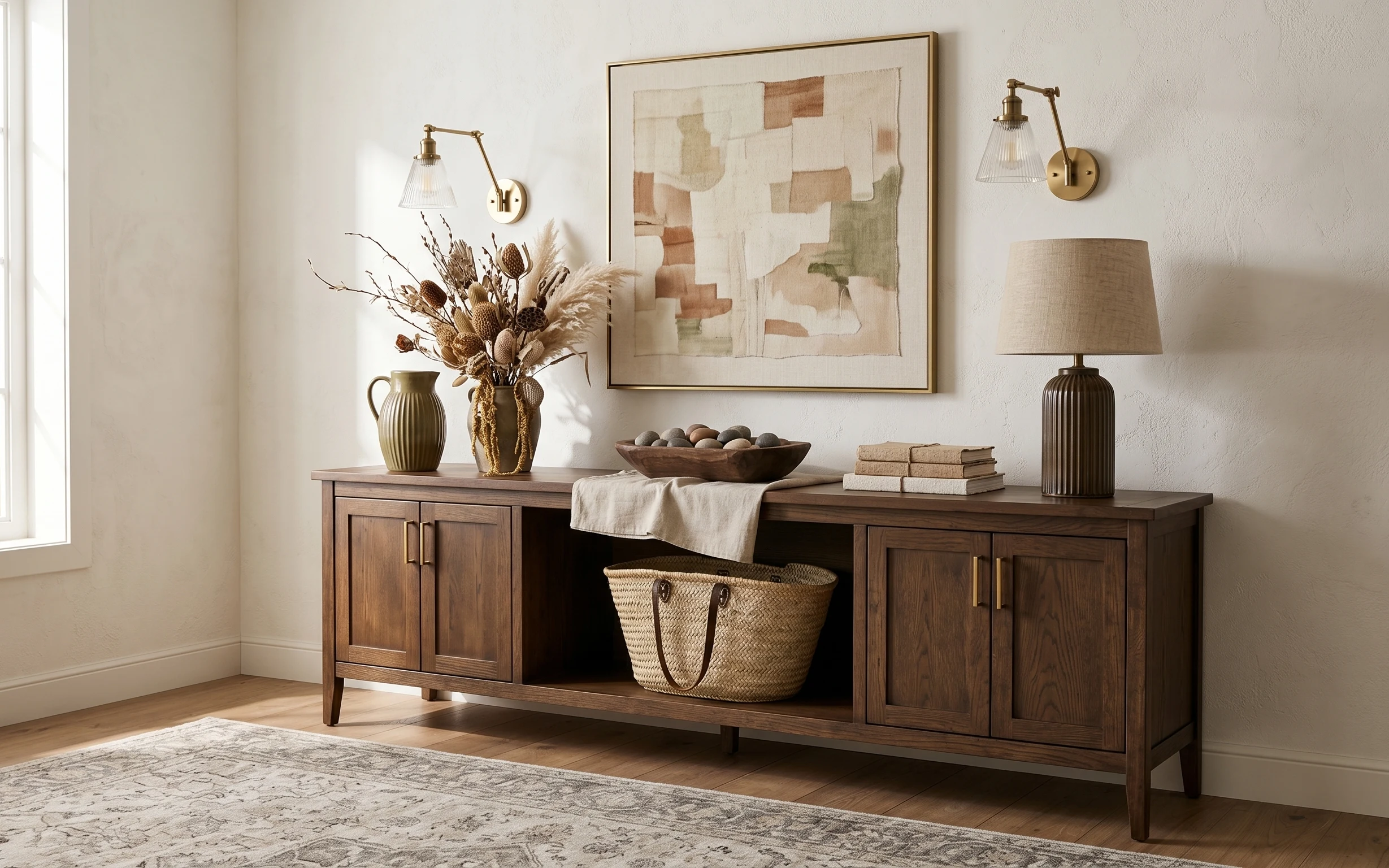
Under $400: move-friendly console table corner refresh
A move-friendly console table corner refresh under $400, built from 7 swappable, packable upgrades: rug, table decor, a brass lamp, and a r…
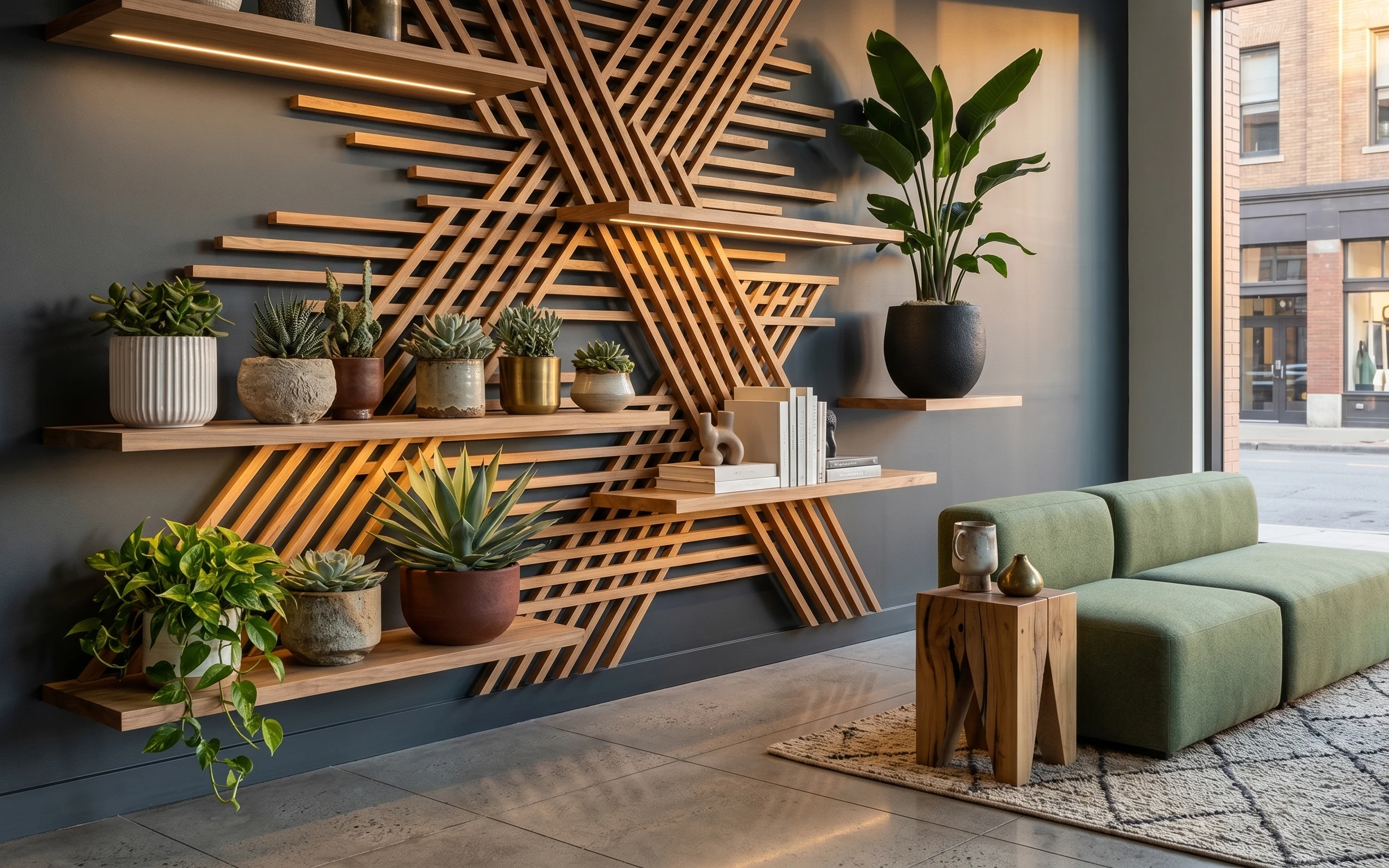
Under $400: renter-friendly sofa wall display refresh
A move-friendly living room refresh built around a renter-safe sofa wall display. With 7 swaps (rug, side table, plants, and styled decor) …