- Best for
- Warm, layered bedroom refresh
- Cost
- Under $700
- Difficulty
- Easy–Moderate weekend upgrades
- Time
- About a weekend
Why warm-taupe bed setup is the bedroom of 2026
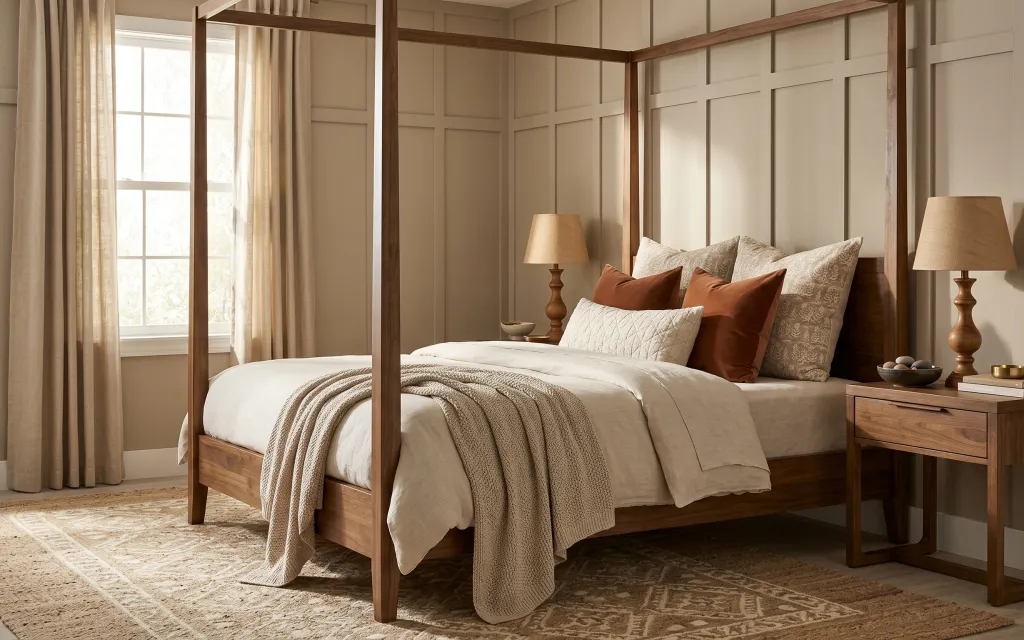
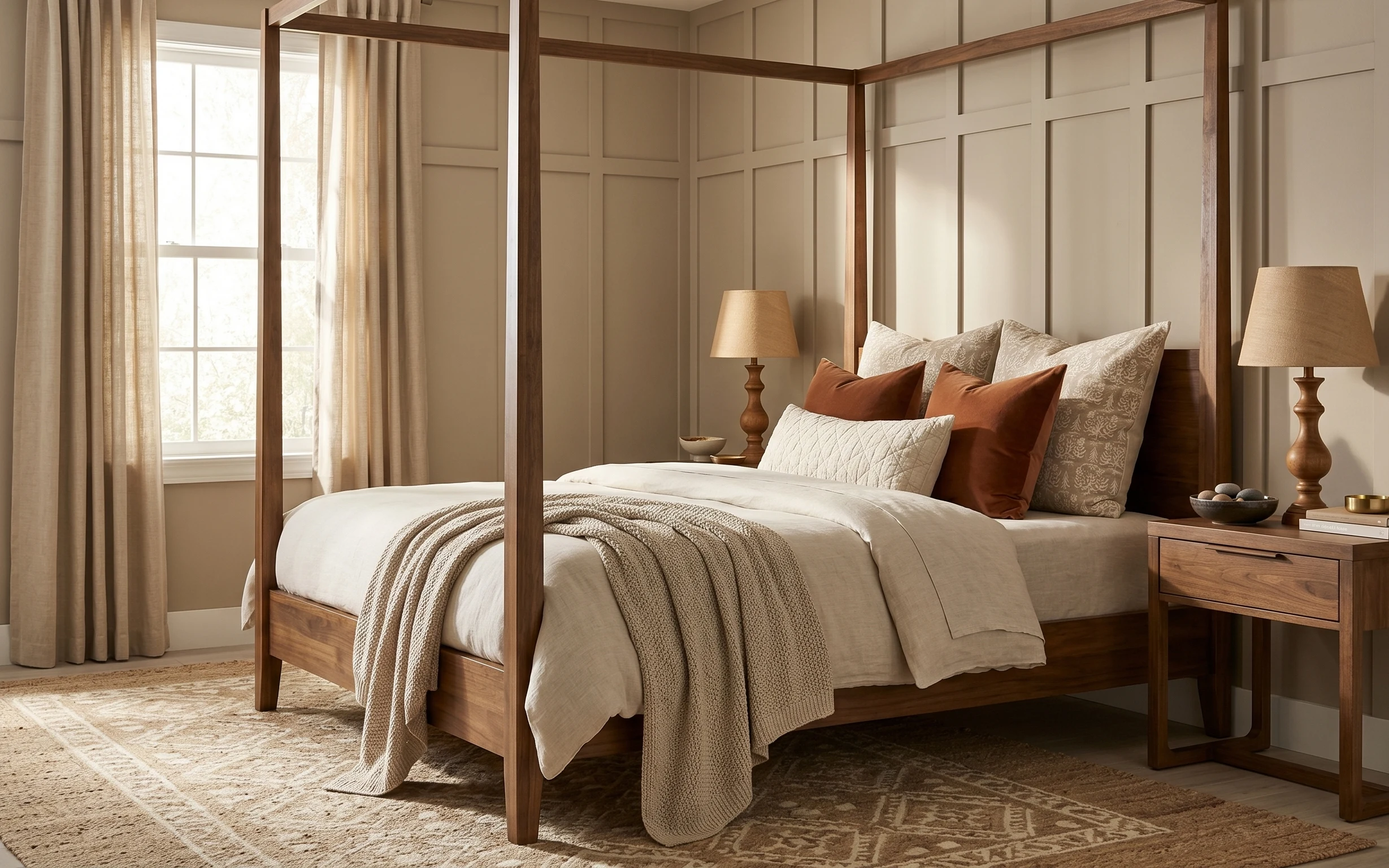
In this bedroom, the first thing you notice is how the warm beige rug, the beige curtain panels, and the walnut-toned wood bed frame all agree on tone. The second is texture: a quilted light duvet, a knit throw blanket, and multiple throw pillows that mix cream and rust without going loud. This is the same kind of restrained, layered approach you see in places like Architectural Digest’s styling rooms—soft neutrals first, then contrast in small doses. For homeowners, it’s a satisfying weekend job because you can choose impact (like the wall backdrop) instead of only what’s reversible.
I almost went down the “matchy-matchy curtains + matched bedding” route when I first styled my own place. What stopped me was realizing the room already has gorgeous paneled detail, so the fabrics shouldn’t compete—they should frame it. Once I focused on repeating the same warm beige across the rug and curtains, the throw pillows suddenly made sense as the accents, not the main event. That’s why this refresh starts with textiles and only then adds the bedside moment.
Layer 1 — large area rug with beige pattern ($200) Anchors the whole room’s color story
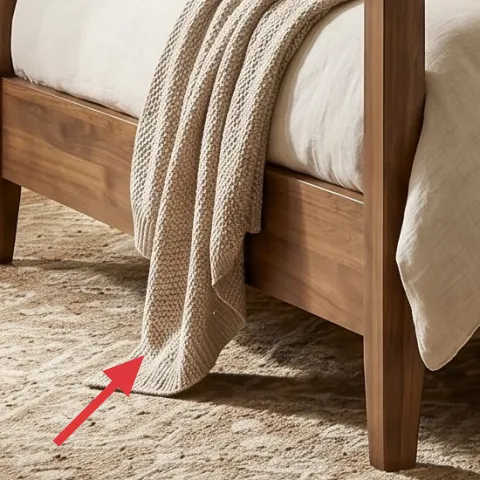
A large area rug with a beige pattern is what makes this bedroom feel grounded instead of visually floaty. In the photo it sits under the bed and runs into the open floor space, so it becomes the “common denominator” for the curtain tone, the quilted light duvet, and the wood furniture. Buying a real rug (not a smaller runner) matters because it hides the seams of the room—where feet, bedding, and dresser traffic all land. The trade-off is storage and vacuuming: thick rugs take a little more care, but they’re worth it for the instantly finished look.
Choose a rug that repeats your curtain beige
If the rug’s undertone matches the beige curtain panels (warm vs. cool), the whole room reads cohesive even when pillows add rust.
Layer 2 — beige curtain panels ($80) Makes the window area feel taller and softer
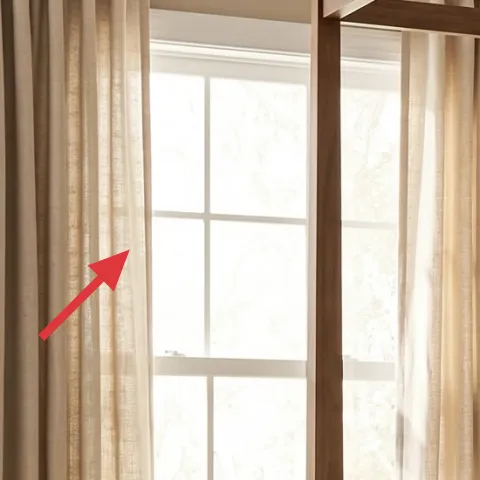
These beige curtain panels add softness around the window, and they also help the wood bed frame feel intentional rather than “placed.” The panels hang in a way that visually stretches upward, which is exactly what a paneled accent wall needs—so the eye travels from vertical trim to fabric. A common cheaper alternative is light blinds or a short set of curtains, but they leave gaps and make the room feel unfinished. The trade-off with curtains is measuring: get the width wide enough to bunch slightly, and hang high enough that the top doesn’t land at a awkward eye-line.
Sheer-to-room balance is the goal
Even with daylight, beige curtains keep the room from looking stark, especially next to the patterned rug.
Layer 3 — knit throw blanket in beige ($50) Adds casual texture over the quilted duvet
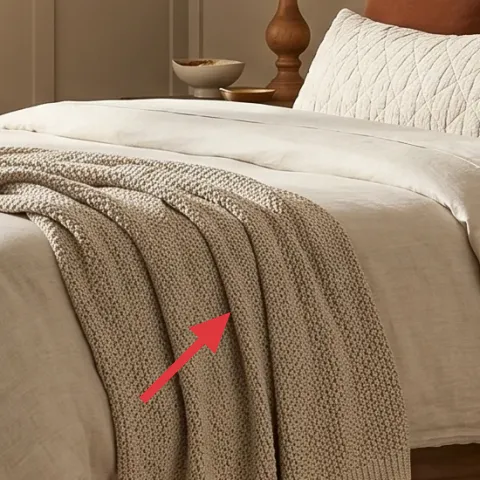
The knit throw blanket in beige is the texture layer that keeps this bedroom from looking too formal. It’s draped over the bed so it reads “used,” not tucked away, and that’s what makes the quilted light duvet feel lived-in. Buying a throw blanket with visible knit texture is better than choosing a smooth throw because the room already has crisp lines in the paneled accent wall and bed frame. The trade-off is that a knit can shed a bit at first—shake it out and keep it away from vacuum brush roll edges until it settles.
Let the throw break the bedding line
If the blanket folds differently on each side, the bed looks styled without trying too hard.
Layer 4 — decorative throw pillows in cream, tan, and rust colors ($30) Brings contrast without leaving the neutral family
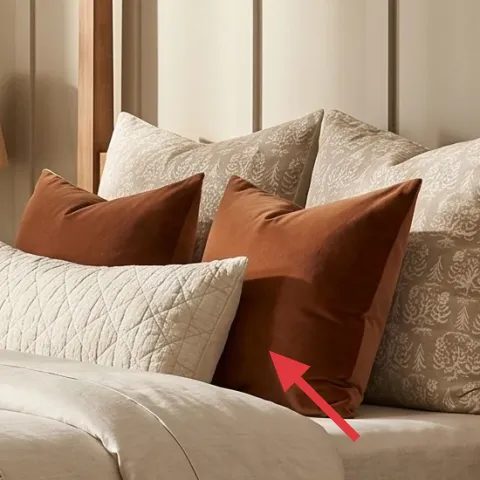
These decorative throw pillows in cream, tan, and rust colors are the “small budget impact” layer because they change the bed’s color temperature more than you’d expect. In the photo, cream pillows sit next to rust pillows, and both are surrounded by lighter fabric so the rust shows up as warmth, not intensity. The obvious alternative—one pillow in a single color—makes the bed look flat against the paneled headboard area. The trade-off: pillow sourcing. It’s easier to buy simple covers and swap the look later than to hunt for perfectly matched printed sets.
Don’t stack all the same texture
If every pillow is quilted or every pillow is smooth, the bed loses that layered, magazine-ready depth.
Layer 5 — wood side table (right) with drawer ($80) Creates a practical styling surface
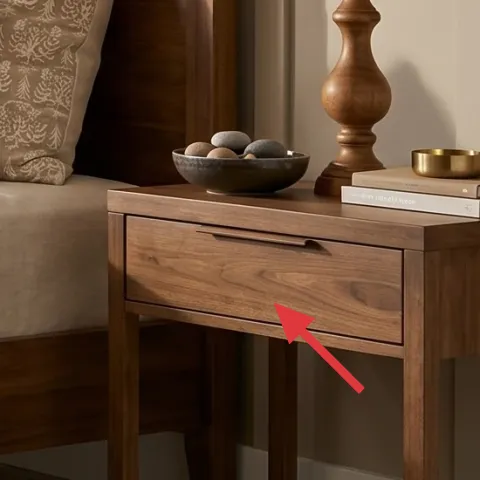
The wood side table with a drawer does two jobs: it gives you a place for the lamp base and it creates a clean “landing zone” for small objects. In this bedroom, the right-side table holds the stack of books and a small side bowl, which makes the vignette look curated without being fussy. Choosing the same wood tone as the bed frame is a smart move here, because it prevents the lamp and accessories from looking randomly placed. The trade-off is size—too small feels wobbly, too large overwhelms the corner, so aim for a compact top that still fits a lamp and a couple of accessories.
Use the drawer to keep the styling honest
When cords and odds-and-ends are put away, the lamps and bowls look intentional instead of cluttered.
Layer 6 — table lamps with tan fabric shades ($60) Adds warm light that matches the bed textiles
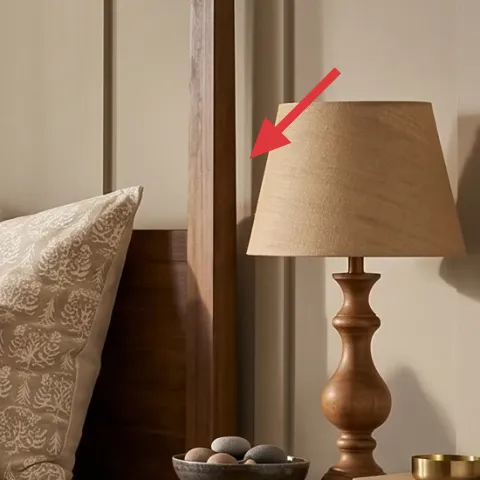
Table lamps with tan fabric shades are what make the bedroom feel soft after dark, and they also visually echo the beige curtain panels. In the photo, the lamp shades sit at two heights, which is a small styling move that keeps the bed area from looking like one flat plane. Buying plug-in or standard lamp bases is usually cheaper than hardwired lighting, and it’s a weekend-friendly upgrade. The trade-off is bulb choice: stick to warm white so the fabric shade reads creamy, not yellow-green under cooler bulbs.
Match lamp warmth to your beige tones
Warm white bulbs help beige fabric stay flattering next to walnut wood and rust pillows.
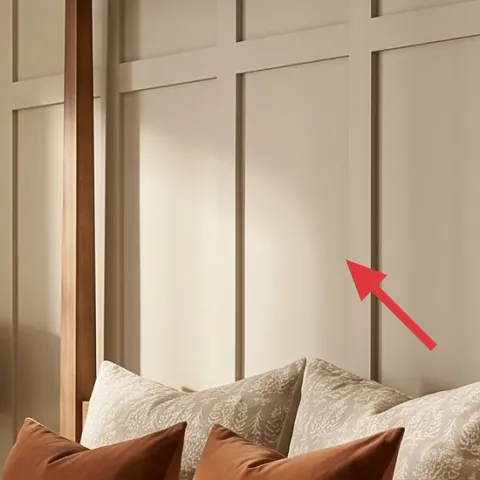
Layer 7 — peel-and-stick wallpaper for the paneled accent wall ($150) Makes the paneled detail look styled
Make it instead of buying it
Use peel-and-stick wallpaper on the paneled accent wall behind the bed so the texture reads intentional without repainting the whole room.
Materials
- Peel-and-stick wallpaper rolls — enough for ~1 wall (about 1 roll to start) — $95
- Plastic smoothing tool/squeegee — 1 — $12
- Utility knife blades (extra pack) — 1 — $8
- Measuring tape + level — 1 kit — $20
Steps
- Measure the paneled accent wall sections and mark the straight starting line with a level.
- Lay out the wallpaper strips on the floor and trim for the first vertical run.
- Peel a small section of backing, align the strip to your line, and press the center first.
- Smooth outward with the plastic tool, pushing air toward the edges and into the recesses.
- Trim around any frame edges with a fresh utility blade for clean corners.
- Repeat for the next panel section, overlapping carefully where needed and trimming at seams.
- Run a final firm pass with the smoothing tool to lock the pattern down.
- Step back, check symmetry around the bed, and do touch-up trimming before you’re done.
Total DIY cost: $135 — saves about $15 over buying.
The cost, layer by layer
| Layer | Item | Cost |
|---|---|---|
| 1 | large area rug with beige pattern | $200 |
| 2 | beige curtain panels | $80 |
| 3 | knit throw blanket in beige | $50 |
| 4 | decorative throw pillows in cream, tan, and rust colors | $30 |
| 5 | wood side table (right) with drawer | $80 |
| 6 | table lamps with tan fabric shades | $60 |
| 7 | peel-and-stick wallpaper for the paneled accent wall (DIY-equivalent) | $150 |
| Total | $650 | |
If you want a cheaper variant, start by swapping only the curtains and pillows first, then use existing bedside items. You can usually keep the same lamp bases and focus budget on either the rug or the peel-and-stick wallpaper, not both.
What worked, what didn't (across the whole room)
The warm beige foundation works because every major surface—floor, rug, curtains, and wood—stays in the same temperature family. The bed looks intentionally styled thanks to texture layering (knit throw + quilted duvet) and a few rust notes in the throw pillows. The only place this look can slip is bedside clutter: small items look great when they stay in a tight vignette.
What worked
- The large beige rug pattern grounds the bed and visually connects curtains, pillows, and wood.
- Beige curtain panels soften the window area and make the wall details feel taller.
- The knit throw blanket adds tactile contrast against the quilted duvet.
- Rust throw pillows give warmth without fighting the paneled accent wall’s geometry.
- The right-side table creates a natural spot for the stack of books and small side bowl.
- Tan fabric lamp shades keep the room flattering in daylight and warm after dark.
What didn't
- If the curtains are too narrow, they lose their soft “frame” effect around the window.
- Using only smooth throws and matching pillows makes the bed look flat against the paneling.
- Two identical lamp heights can make the bedside vignette feel staged instead of lived-in.
- Wallpaper seams that don’t line up with the panel recesses can be more noticeable than paint touch-ups.
What we'd skip if we did it again
Skip replacing everything at once. In this bedroom look, the real wins come from repeating the warm beige in the rug and curtains first, then adding texture with the knit throw and pillows. Swapping one big “surface” (like the rug) and one small “accent” at a time keeps spending under control and prevents decision fatigue.
Skip a short curtain set. If the curtain panels don’t hang with enough width and height, the room loses that airy frame around the paneled headboard area. It’s one of those upgrades that’s easy to underestimate—paying attention to both length and width makes the whole window feel designed.
Skip cool-white bulbs for the tan fabric lamp shades. The shade color will read wrong next to walnut brown and beige textiles, and the rust pillows won’t feel as warm. Warm white makes the entire bedroom palette look cohesive and more expensive, with no extra decor purchases.
Frequently asked
How long does this bedroom refresh take for a first-time DIYer?
The textiles (rug placement, curtains, and pillow styling) usually take a couple of hours. The peel-and-stick wallpaper on a paneled accent wall is the time wildcard—plan for careful measuring, aligning, and trimming around recesses. For most homeowners, expect around one full weekend: one day for wall prep and first pass, and a second day for smoothing, final trims, and styling the bed and bedside table.
Can I do this if I rent or if I can’t change the wall much?
Yes—lean into the layers that don’t require wall changes. Prioritize the large area rug, beige curtain panels, and the knit throw blanket and throw pillows. For the wall, you can keep the paneled accent wall as-is and use framed art or peel-and-stick accents only if your lease allows. The lighting and bedside vignette can still create a very similar “styled” result without touching the wall.
What if my bedroom is smaller than this one?
Keep the rug idea, but go slightly smaller while still choosing a rug that reaches under the bed (or at least under the front edge). For curtains, keep the same “tall and wide” principle—hang high and make sure the panel width can gently pool or bunch. For pillows, reduce to fewer covers (for example, one cream, one tan, one rust) so the bed stays airy.
What if my bedroom is bigger and feels empty?
Go bigger with the rug and consider adding two lamp statements (if you have space) or a larger bedside table surface so the stack of books and small side bowl don’t look lost. You can also extend the curtain width beyond the window frame to create that full, framed effect. The paneled accent wall is a strong anchor—wall wallpaper can help it feel like a deliberate backdrop rather than a separate feature.
Where should I shop differently for the best budget results?
Start with curtains and pillows at stores with good basics and frequent sales, because these are easy to swap later. For the rug, it’s worth paying for a real size that fits the bed scale—look for mid-range sales rather than bargain runners. For lighting, buy a lamp base and shade you actually like; the tan fabric shade color matters as much as the price.
What’s the biggest mistake people make in this kind of bedroom styling?
Overbuying matchy sets. When every piece is the same color and texture, the room can look flat even if it’s expensive. Aim for one warm neutral foundation (rug + curtains + duvet), then add contrast through rust pillows and tactile contrast with a knit throw. That mix is what makes the bed look styled and lived-in at the same time.
More in Bedroom
Under $700: warm-taupe bedroom refresh with 7 budget swaps
A warm-taupe bedroom refresh on a $700 weekend budget: update the beige rug, curtains, throw layers, and bedside lighting for a calm, lived…
Under $400: move-ready bedroom refresh with 7 easy swaps
A move-friendly bedroom refresh that leans into olive-and-cream textures and warm light, built for renters and shared housing. This plan us…
Under $500: beige-and-rust bedroom sanctuary refresh
A move-friendly bedroom sanctuary refresh built around warm string lights, layered neutrals, and framed art that packs into boxes. This pla…